Services
Yacht Project Management
From concept to final delivery. A single point of responsibility for the whole process.
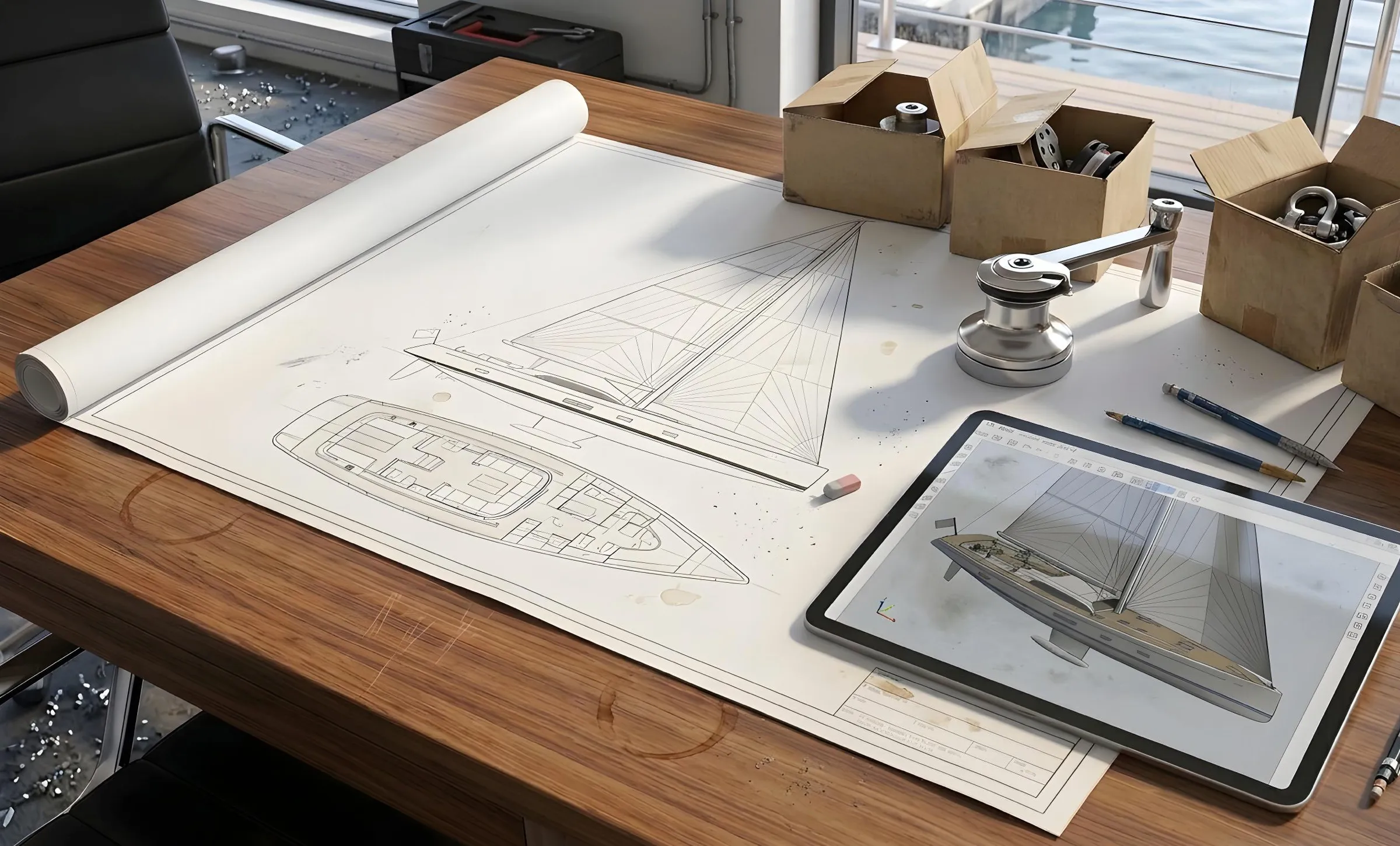
One partner, not a dozen suppliers
Building or refitting a yacht means working with dozens of parties — the yard, the designer, suppliers of rigging, sails, hardware, electronics, interiors, propulsion. Without a single point of accountability, risk spreads between parties — and costs grow.
Project management is the role of the owner's representative — we represent the owner's interest at every stage. We coordinate suppliers, enforce quality, guard the schedule and the budget. The owner has one person to talk to, not a dozen.
Our work comes down to one thing: we understand the owner's expectations, translate them into specific technical requirements, and make sure the yard delivers exactly those requirements — not its own interpretation. Without this step, expectations and reality drift apart across hundreds of pages of specifications.
New builds and existing yachts
We cover the full range — from brand-new yachts built from a blank contract to deep refits of decades-old vessels.
- New build — a new yacht from yard contract to handover
- Refit — renovation and modernization of existing yachts
- Upgrade — targeted upgrades of systems, rigging or interior
The triangle of quality, cost and time
Every yacht project operates within a triangle of three constraints: quality, cost, time. Each vertex can be stretched — but always at the expense of the other two. Our job is to keep these three dimensions balanced according to the owner's intent — and whenever something has to change, to show the trade-off openly, not under the carpet.
What our work covers
- Feasibility studies before the project starts
- Pre-purchase surveys for existing yachts
- Vendor assessment — selection of yard, designer, subcontractors
- On-site production supervision — regular visits, reports, photo documentation
- Quality control — staged acceptances, tests, protocols
- Classification society coordination
- Material and component certification verification
- Schedule management (time management, milestones, critical path)
- Budget control (cost control, change orders, contingency planning)
- Integration of deck, electrical and navigation systems
- Change management
- Final acceptance, sea trials, handover
- Warranty management — oversight during the post-delivery warranty period
During the project we use digital tracking tools — visual reports, 3D coordination models and a status dashboard accessible to the owner at any time.
How we run a project
- 01 · Brief and analysis — owner's goals, budget envelope, location, schedule
- 02 · Concept and scope — technical specification, supplier list, work plan
- 03 · Contracting — negotiations with yard and suppliers, acceptance terms, safeguards
- 04 · Supervision and execution — daily coordination, on-site visits, reporting
- 05 · Acceptance and handover — tests, sea trials, documentation, handover to owner
- 06 · Post-delivery care — warranty, service, future seasons
What the owner gains
- Full control — one report, one schedule, one budget
- Reduced risk — early issue detection and contingency planning before problems get expensive
- Predictability — clear milestones, clear rules for scope change, no budget surprises
- Resource efficiency — optimized cost, eliminated unnecessary spend, efficient use of supplier time
- Independence — we represent the owner, not the yard or a supplier
- Transparency — regular financial and technical reports, full visibility at every stage
Five traits that make the difference
Not every PM is the same. In our experience, these five things decide whether a project lands on time and on budget — or drifts.
- Solid technical experience — we understand what the yard and suppliers have to build, because we've worked in rigging, production and quality control ourselves.
- An eye for detail — half of all production issues are small inconsistencies that only close supervision catches.
- Integrity and the confidence to say "no" — the owner is best represented by someone willing to challenge an unsuitable proposal from the yard or a supplier.
- Communication rhythm that fits — some owners want daily reports, others quarterly. We adapt to the owner's preference; we don't impose our own cadence.
- A good personal relationship — a project means 18–36 months of working together. Without trust, it doesn't work.
Experience that pays back
The Sails Projects team brings together operational, technical, and sailing expertise — from years of rigging practice on world-class regattas, through production supervision and QA in the marine industry, to direct oversight of yacht builds and refits.